

Here's a polished, engaging, and customer-friendly version perfect for your product page or livestock section:
Neptune Grouper / Garish Hind (Cephalopholis igarashiensis)
This rare and stunning deep-water grouper is highly sought after for its vibrant coloration and dramatic appearance.
Appearance & Identification The Neptune Grouper has a deep, robust body (body depth greater than head length) with a standard length 2.0–2.4 times the body depth. It features a straight to slightly concave head profile and a distinctly convex nape.
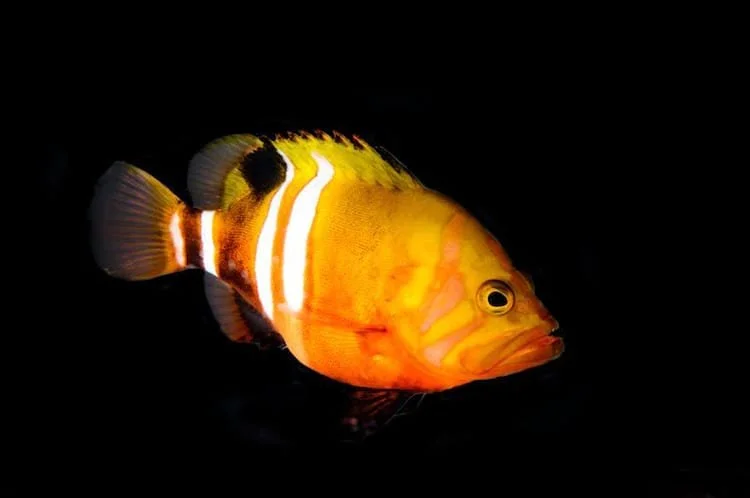
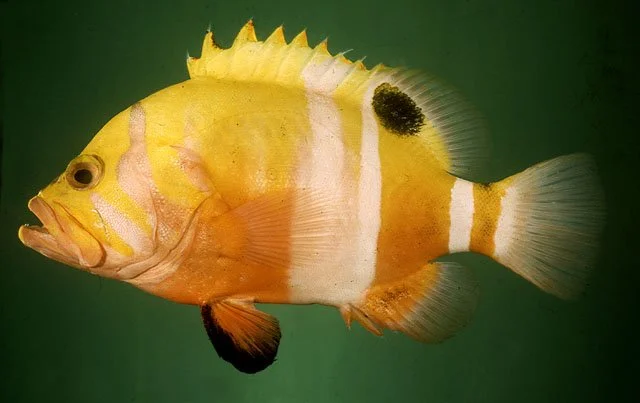
Its striking coloration consists of a rich reddish-orange base accented by seven wide, bright lemon-yellow bars along the upper flanks that extend onto the dorsal fin, plus three irregular yellow oblique stripes on the head. Juveniles are even more vivid, often showing a large black eyespot on the dorsal fin and blackish pelvic fins.
Key Features
Dorsal fin: 9 spines + 14 soft rays
Anal fin: 3 spines + 9 soft rays
Rounded caudal fin
Maximum size: 43 cm (17 in) — more commonly 25 cm (10 in) in captivity
Care Notes As a deep-water species, the Neptune Grouper prefers lower lighting and very stable water parameters. It is a predator that requires a spacious tank (minimum 180–300+ gallons for adults) with strong filtration and plenty of hiding spots. It is reef-safe with most corals but may eat small fish and crustaceans.
This is a true showpiece fish for advanced reefers looking for something extraordinary.
Here's a polished, engaging, and customer-friendly version perfect for your product page or livestock section:
Neptune Grouper / Garish Hind (Cephalopholis igarashiensis)
This rare and stunning deep-water grouper is highly sought after for its vibrant coloration and dramatic appearance.
Appearance & Identification The Neptune Grouper has a deep, robust body (body depth greater than head length) with a standard length 2.0–2.4 times the body depth. It features a straight to slightly concave head profile and a distinctly convex nape.
Its striking coloration consists of a rich reddish-orange base accented by seven wide, bright lemon-yellow bars along the upper flanks that extend onto the dorsal fin, plus three irregular yellow oblique stripes on the head. Juveniles are even more vivid, often showing a large black eyespot on the dorsal fin and blackish pelvic fins.
Key Features
Dorsal fin: 9 spines + 14 soft rays
Anal fin: 3 spines + 9 soft rays
Rounded caudal fin
Maximum size: 43 cm (17 in) — more commonly 25 cm (10 in) in captivity
Care Notes As a deep-water species, the Neptune Grouper prefers lower lighting and very stable water parameters. It is a predator that requires a spacious tank (minimum 180–300+ gallons for adults) with strong filtration and plenty of hiding spots. It is reef-safe with most corals but may eat small fish and crustaceans.
This is a true showpiece fish for advanced reefers looking for something extraordinary.